
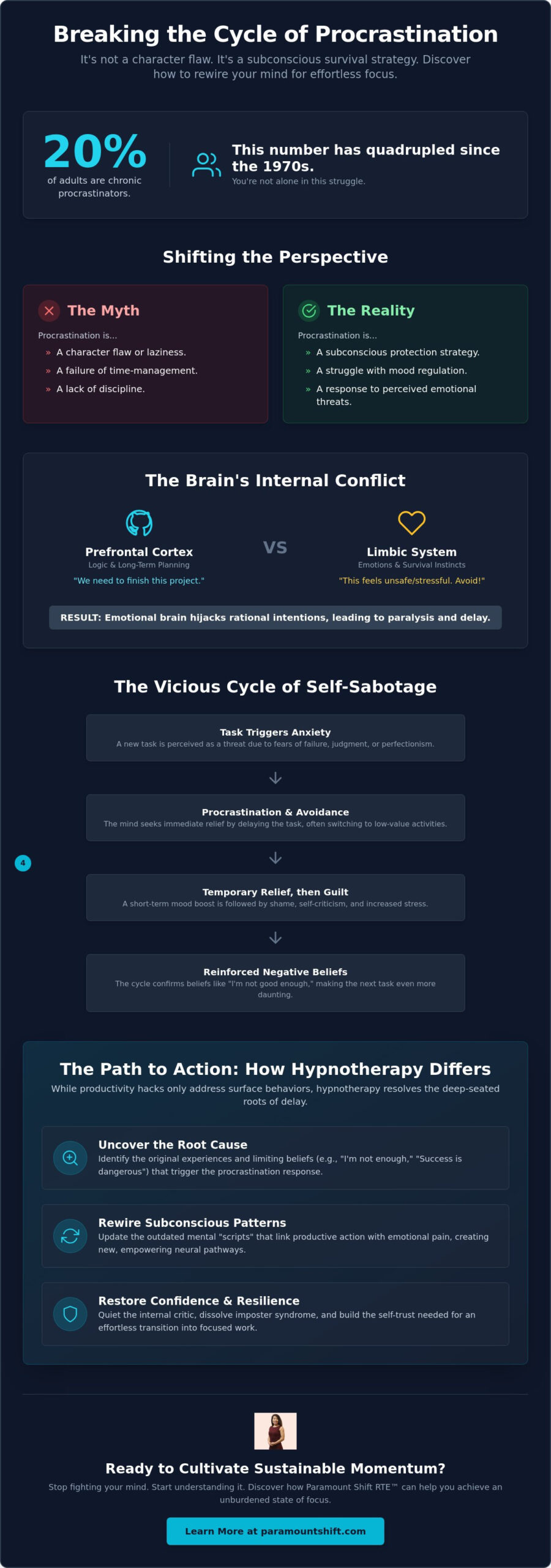
What if the reason you can’t start that project has nothing to do with laziness and everything to do with a subconscious survival mechanism? You’ve likely tried every time-management app and productivity hack available, yet that familiar knot of physical tension still tightens in your chest the moment you open a new task. It’s a frustrating cycle of chronic guilt and the constant fear of being found out as incompetent despite your actual skills. You aren’t alone in this struggle; since the 1970s, the number of people identifying as chronic procrastinators has quadrupled to 20 percent of the adult population. Utilizing hypnotherapy for procrastination offers a way to stop fighting your own mind and start understanding the emotional architecture that keeps you stuck.
This article moves beyond surface-level advice to explore how professional hypnotherapy resolves the deep-seated roots of delay. You’ll discover how to quiet the internal critic that fuels your imposter syndrome and restore the self-trust necessary for professional confidence. By addressing the foundational fears that trigger avoidance, we’ll outline a path toward an effortless transition into focused work and a more resilient, unburdened state of being.
Key Takeaways
- Reframe procrastination as a subconscious safety strategy rather than a lack of discipline or a character flaw.
- Identify why traditional productivity hacks fail to bridge the internal gap between your logical goals and emotional resistance.
- Explore how hypnotherapy for procrastination uncovers and resolves the original experiences that make starting new tasks feel unsafe.
- Discover the role of Paramount Shift RTE™ in building professional resilience and restoring a natural, unburdened state of focus.
Beyond the Laziness Myth: Understanding Procrastination as Protection
Most people view procrastination as a character flaw, a judgment that only deepens the cycle of shame and self-reproach. In reality, it represents a profound misalignment between your conscious ambitions and a subconscious mind that perceives certain tasks as threats to your emotional safety. Your mind isn’t trying to sabotage your career; it’s desperately trying to keep you safe from the emotional exposure that comes with high-stakes work. By shifting our perspective from “laziness” to “protection,” we create a non-judgmental sanctuary where genuine change can begin.
Extensive psychological research on procrastination suggests that this behavior is primarily a struggle with mood regulation rather than a lack of discipline. Your brain prioritizes short-term mood repair, seeking immediate relief from the anxiety or boredom of a task, even at the expense of your long-term goals. This often manifests as “productive procrastination,” where you stay busy with low-value tasks like organizing your inbox or tidying your workspace. By doing this, your mind maintains the illusion of progress while successfully avoiding the primary goal that feels emotionally taxing.
The Emotional Architecture of Avoidance
When you face a daunting project, your amygdala may interpret the challenge as a genuine threat, triggering a “fight, flight, or freeze” response. This reaction is particularly intense for those who struggle with perfectionism, where an impossible standard creates a fear of failure so great that the mind chooses to freeze entirely. Procrastination is a subconscious survival strategy developed to prevent perceived emotional pain.
Procrastination and Imposter Syndrome: The Hidden Link
Delaying a task often provides a convenient “built-in excuse” for potential failure; if the work isn’t your best, you can blame the lack of time rather than a lack of ability. This “safety shield” also protects you from the fear that success will lead to even higher expectations you might not be able to meet. Through hypnotherapy for procrastination, we can identify the specific moment this defensive pattern was first adopted. This process allows for a compassionate resolution of the underlying fear, moving you toward a state of unburdened focus and genuine self-trust. Utilizing hypnotherapy for procrastination helps demystify these internal barriers, replacing the heavy weight of delay with a renewed sense of professional agency.
The Subconscious Architecture: Why Your Mind Chooses to Delay
To understand why we delay, we must first look at the internal tug-of-war occurring within the brain. Your prefrontal cortex, the seat of logic and long-term planning, knows exactly what needs to be done to achieve your goals. However, the limbic system, which governs emotions and survival instincts, often perceives the effort or potential judgment of a task as a threat. According to research on the psychology of procrastination, this conflict creates a state of paralysis where your emotional brain effectively hijacks your rational intentions.
Your subconscious mind operates on a foundational principle of protection. It never acts with the intent to harm you; instead, it relies on outdated data from your past to keep you safe in the present. If your mind associates high-performance with exhaustion, or visibility with criticism, it will create a wall of resistance. Common root beliefs like “I am not enough” or “Success is dangerous” act as invisible anchors. When you try to start a task, these beliefs manifest as physical sensations, such as a tightening in the chest, a knot in the stomach, or a sudden, overwhelming fatigue that seems to appear out of nowhere.
How Limiting Beliefs Dictate Productivity
Your professional output is rarely a measure of your skill; it’s a reflection of your internal self-image. If childhood experiences involved harsh criticism or the pressure to be perfect, your adult mind might view every new project as a trial of your worth. This is where rapid transformational therapy becomes essential. It allows us to pinpoint the specific triggers that link past emotional wounds to current work habits. By updating these old scripts, hypnotherapy for procrastination helps you dismantle the barriers between your potential and your daily actions.
The Feedback Loop of Self-Sabotage
Procrastination creates a punishing cycle: anxiety leads to avoidance, which provides a fleeting moment of relief. This relief is quickly replaced by guilt, which increases anxiety for the next task. Willpower is a finite resource; it’s like trying to hold a beach ball underwater. Eventually, the subconscious resistance will push back. Addressing the emotional block at its source stops this loop permanently. If you find yourself caught in this pattern, exploring Paramount Shift RTE™ can provide the structural support needed to rewire these responses and restore your natural momentum.
Why Traditional Productivity Hacks Fail (And How Hypnotherapy Differs)
Most professionals have a drawer full of unused planners and a phone cluttered with time-management apps. These tools, along with methods like “Eat the Frog” or the Pomodoro technique, are designed to organize your time, but they fail to address the emotional weight you carry into that time. Using these hacks is often like trying to fix a software crash by polishing the computer screen. They address the user interface of your daily life while the underlying operating system remains glitched. When you rely solely on external structures, you ignore the internal friction that makes starting feel impossible.
This friction is what we call the “Willpower Gap.” It’s the exhausting space where your conscious effort slams into a wall of subconscious resistance. While traditional talk therapy operates from the top down, trying to analyze the problem through logic, hypnotherapy works from the bottom up. It bypasses the critical conscious mind to access the source of the delay. The Mayo Clinic highlights the efficacy of hypnotherapy for behavior change, noting its ability to help individuals achieve a state of focused attention where they are more open to transformative suggestions. By addressing the root instead of the symptom, hypnotherapy for procrastination provides a permanent resolution rather than a temporary patch.
Willpower vs. Subconscious Reprogramming
Conscious discipline requires a massive amount of energy, making it a finite and unreliable resource. If you try to use positive affirmations that contradict a core belief, such as “I am highly productive” while feeling like a failure, your mind will reject the statement as a lie. True alignment happens when your core beliefs support your goals. Through root cause therapy, we remove the “mental viruses” that trigger avoidance, making action feel like a natural choice rather than a forced labor.
The Role of RTT in Rapid Change
For time-sensitive professionals, the speed of transformation is vital. Rapid Transformational Therapy (RTT) is particularly effective because it combines the most impactful elements of hypnotherapy, CBT, and neuroplasticity. It doesn’t just help you meet a deadline; it fundamentally shifts how you perceive your own capability. This approach facilitates a total life transformation, ensuring that the clarity and confidence you gain in your workspace ripple out into every other area of your existence. Using hypnotherapy for procrastination ensures that your internal architecture is finally built to support your highest ambitions.
The Path to Action: How Hypnotherapy Rewires the Procrastination Loop
Many people hesitate to try hypnosis because they associate it with a loss of control or a mysterious, passive state. In professional practice, the hypnotic state is actually a period of heightened awareness and focused attention. It’s a deeply relaxed environment where your critical conscious mind steps aside, allowing us to communicate directly with the subconscious. Think of it as a collaborative partnership where you remain fully in control, using this quiet space to update the internal software that has been running on outdated, defensive scripts. By utilizing hypnotherapy for procrastination, we move beyond simple relaxation into active cognitive restructuring.
The process begins with an investigation into the “why” behind your delay. We trace the current feeling of resistance back to the first time your mind felt “unsafe” or overwhelmed by a task, identifying the origin of the protection mechanism. Once we find that root, we move into the interruption phase. This is where we break the link between professional effort and the fear of judgment or failure. Finally, the installation phase creates new, empowering neural pathways. We plant the seeds of self-trust and agency, ensuring that your mind views starting a task as a safe and rewarding experience rather than a threat to be avoided.
What to Expect During a Session
Your sessions are held in a judgment-free, nurturing sanctuary designed for your personal evolution. This isn’t a passive experience; it’s a dynamic dialogue between you and the practitioner. Much like hypnotherapy for overthinking, the goal is to quiet the noise of the internal critic and restore a sense of clarity. You’ll leave feeling grounded and empowered, with a clear understanding of the mechanics behind your transformation. The partnership is built on psychological safety, ensuring you feel supported as you dismantle long-standing barriers.
Post-Session Integration and Momentum
The work continues after you leave the session through personalized audio recordings. These recordings reinforce the new beliefs installed during our time together, helping to solidify the neural changes and make them permanent. Most clients report that the heavy urge to procrastinate simply begins to fade within the first few weeks. Instead of forcing yourself to work through sheer willpower, you’ll find your “start-up” energy returns, allowing for a fluid transition into productive focus. If you’re ready to break the cycle and reclaim your time, you can book a session to begin your transformation today.
Cultivating Sustainable Momentum with Paramount Shift
The modern professional landscape is relentless. With 88 percent of employees admitting to daily delay, the cost of this internal friction isn’t just financial; it’s a tax on your mental peace. Moving beyond the mechanics of hypnotherapy for procrastination requires a structured path that respects both your professional ambitions and your emotional wellbeing. True success isn’t built on the back of exhaustion or constant self-reproach. It’s found in the restoration of a natural, unburdened state where your work flows from a place of clarity rather than a place of fear.
Sustainable change happens when we stop treating our minds as obstacles to be overcome and start treating them as partners to be aligned. By addressing the emotional architecture of your delay, you create a foundation for external success that feels effortless. This evolution represents a shift from being “stuck” in a cycle of avoidance to living in a state of “flow,” where the transition into focused work becomes your default setting. Utilizing professional hypnotherapy for procrastination ensures that your internal environment is as organized and powerful as your external goals.
The Paramount Shift RTE™ Methodology
The Paramount Shift RTE™ protocol is specifically designed for high-performance individuals who find themselves hindered by the invisible weight of imposter syndrome and delay. Unlike generic coaching that focuses on surface-level habits, this methodology uses subconscious tools to target the specific intersection of your professional identity and your survival instincts. The founder, Jing, delivers this protocol with clinical precision and deep, compassionate empathy. This isn’t just about meeting deadlines; it’s about a profound realignment of your self-image. By removing the specific triggers that cause you to freeze, the program allows you to reclaim the mental energy previously wasted on anxiety and guilt. For leaders seeking to restore their executive edge, hypnotherapy for concentration in Dubai and across the UAE offers a targeted path to eliminating mental clutter and unlocking elite focus.
Begin Your Evolution
It’s time to stop the exhausting cycle of “trying harder” with the same outdated internal scripts. Real transformation requires you to start “changing deeper.” Imagine a workday characterized by a quiet mind, a steady pulse, and the calm execution of your most important tasks. This version of your life isn’t a distant dream; it’s the natural result of resolving your subconscious resistance. For those seeking even broader alignment across all areas of their existence, we invite you to explore the Super Attractor Program. Your journey toward a liberated, high-performance mindset begins with the simple decision to address the root of your delay today.
Reclaim Your Focus and Professional Peace
Your struggle with delay isn’t a sign of weakness; it’s an outdated survival strategy that no longer serves your higher goals. We’ve explored how the mind prioritizes short-term emotional safety over long-term achievement, creating a barrier that willpower alone cannot break. By utilizing hypnotherapy for procrastination, you can finally bridge the gap between your intentions and your actions, replacing chronic guilt with a natural, unburdened flow of productivity.
As a Certified RTT Practitioner and Hypnotherapist, I offer a personalized, judgment-free approach to resolving the deep-seated emotional blocks that hold you back. My focus is on delivering rapid, sustainable results specifically tailored for high-performers who are ready to excel without the heavy weight of self-sabotage. You deserve a professional life characterized by clarity and calm execution. Begin your transformation with Paramount Shift and step into a future where your potential is fully realized. Your evolution toward a more resilient, focused self starts now.
Frequently Asked Questions
Is hypnotherapy for procrastination effective for long-term change?
Yes, it is highly effective because it resolves the emotional root rather than just offering a temporary productivity hack. By updating the subconscious scripts that trigger avoidance, the change becomes a natural part of your identity. This creates a sustainable shift in behavior that lasts because the internal friction has been permanently removed, allowing you to act without the typical resistance.
How many sessions of hypnotherapy are usually needed to stop procrastinating?
Most individuals require between 6 to 12 sessions to achieve lasting results for deep-rooted issues like chronic delay. While some clients notice a significant shift in their energy after just 1 to 3 sessions, complex behavioral loops often need more time to be fully unraveled. The specific duration depends on your personal history and the complexity of your subconscious protection mechanisms.
Will I lose my “edge” or “creativity” if I stop using pressure to motivate myself?
No, you won’t lose your edge; you’ll actually gain access to a more fluid and sustainable form of creativity. Motivating yourself through fear and pressure creates high levels of cortisol, which eventually leads to burnout and cognitive fatigue. By resolving the root cause, you move into a state of “flow” where your best work emerges from clarity rather than a desperate attempt to avoid failure.
Can hypnotherapy help with procrastination caused by ADHD or neurodivergence?
Yes, hypnotherapy for procrastination is a valuable tool for neurodivergent individuals, as it helps manage the emotional dysregulation often associated with ADHD. While it isn’t a cure for neurodivergence, it can significantly reduce the secondary anxiety and shame that compound executive dysfunction. By quieting the internal critic, it allows you to utilize your unique cognitive style without the heavy burden of self-reproach.
What is the difference between laziness and subconscious procrastination?
Laziness is a lack of desire to act, whereas subconscious procrastination is a conflict between your desire to achieve and your mind’s need for safety. Procrastinators often feel a deep sense of guilt and physical tension because they actually want to complete the task. This distinction is vital because laziness is a choice, while procrastination is an involuntary protection mechanism triggered by the brain’s limbic system.
Is it possible to be hypnotized against my will during a session?
No, it is impossible to be hypnotized against your will because all hypnosis is essentially self-hypnosis. You remain fully aware and in control throughout the entire process. The practitioner acts as a guide, but your mind will only accept suggestions that align with your personal values and goals. If a suggestion feels uncomfortable or wrong, your conscious mind will simply reject it immediately.
What happens if I cannot be hypnotized? Does the therapy still work?
Almost everyone with a normal level of concentration can enter a hypnotic state, as it is a natural experience similar to being absorbed in a book. Even if you don’t feel “deeply under,” the therapy is still effective because your subconscious remains receptive to suggestion. The success of the session depends on your willingness to engage and follow the process rather than achieving a specific level of trance.
How does hypnotherapy address the fear of failure that causes delay?
Hypnotherapy addresses the fear of failure by identifying the specific past experiences where your mind first linked “effort” with “emotional pain.” Once these memories are processed, we use the hypnotic state to install new beliefs that decouple your self-worth from your professional output. This removes the “safety shield” of delay, allowing you to view challenges as opportunities for growth rather than threats to your identity.